
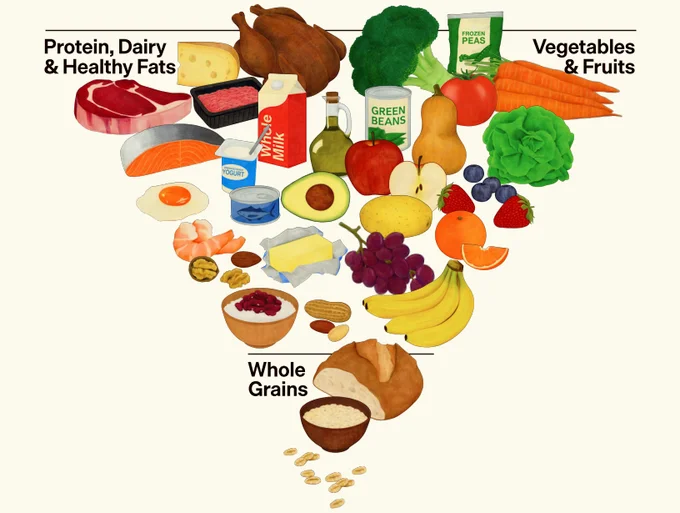
Robert Kennedy Jr dietary guidelines mark a seismic shift in federal nutrition policy, inverting the traditional food pyramid to prioritize meat, healthy fats, fruits, vegetables at the top while relegating whole grains to the base. Announced by HHS Secretary Robert F. Kennedy Jr., these guidelines champion his “Make America Healthy Again” (MAHA) agenda, targeting chronic disease through Robert Kennedy Jr dietary guidelines that emphasize real, nutrient-dense foods over processed carbohydrates.

Core Principles of Robert Kennedy Jr Dietary Guidelines
The Robert Kennedy Jr dietary guidelines fundamentally reject decades of low-fat dogma. Kennedy declared an end to “the war on saturated fats,” positioning protein and healthy fats as dietary cornerstones. The new pyramid structure reflects this priority:
- Top Tier (Widest): Meat, poultry, eggs, seafood, full-fat dairy, nuts, avocados
- Equal Priority: Fruits and vegetables (3+ vegetable servings, 2+ fruit daily)
- Base (Narrowest): Whole grains (2-4 servings), minimizing refined carbs
Kennedy’s core message—”eat real food”—targets ultra-processed foods, sugar-sweetened beverages, and chemical additives as primary health villains. Robert Kennedy Jr dietary guidelines recommend 1.2-1.6g protein per kg body weight daily across all meals, doubling previous minimums for children to support growth and development.
Scientific and Celebrity Endorsements
Stanford neuroscientist Andrew Huberman praised the Robert Kennedy Jr dietary guidelines, calling them “spot on” while suggesting minor vegetable increases and fermented foods like sauerkraut. Huberman noted Americans needn’t consume every recommended food—his personal aversion to shrimp illustrates flexible application.


Former FDA Commissioner Dr. David Kessler hailed the shift toward whole foods and reduced processed carbs as a “major advance.” The American Medical Association’s Dr. Bobby Mukkamala affirmed Robert Kennedy Jr dietary guidelines validate “food is medicine,” targeting sugar, sodium, and processing that fuel heart disease and diabetes epidemics.
Controversial Elements in Robert Kennedy Jr Dietary Guidelines
Not all reactions celebrate Robert Kennedy Jr dietary guidelines. Critics highlight red meat and full-fat dairy prominence despite decades of research linking saturated fats to cardiovascular risk. Stanford’s Christopher Gardner, formerly of the Dietary Guidelines Advisory Committee, called the pyramid “very disappointing,” arguing it contradicts established evidence.
Neal Barnard of the Physicians Committee for Responsible Medicine labeled Robert Kennedy Jr dietary guidelines industry-influenced, though acknowledging fruit/vegetable emphasis and alcohol limits as positives. The guidelines maintain saturated fat below 10% of calories—consistent with prior standards—but elevate sources like butter, beef tallow, and full-fat dairy over previous low-fat recommendations.

Practical Implementation of Robert Kennedy Jr Dietary Guidelines
Robert Kennedy Jr dietary guidelines translate into actionable daily patterns:
| Meal | Robert Kennedy Jr Dietary Guidelines Focus |
| Breakfast | Eggs, full-fat Greek yogurt, berries, nuts |
| Lunch | Grilled chicken salad, olive oil dressing, whole grain minimal |
| Dinner | Steak or salmon, 2+ vegetable sides, small whole grain portion |
| Snacks | Cheese, fruit, nuts, avoid processed/sugary options |
The guidelines endorse cooking fats like olive oil, butter, tallow over seed oils Kennedy criticizes. Gut health emerges as a new priority, noting processed foods disrupt digestion—a novel federal acknowledgment.

Long-Term Impact of Robert Kennedy Jr Dietary Guidelines
Valid through 2030, Robert Kennedy Jr dietary guidelines will shape school lunches, federal food programs, and nutrition labeling. Kennedy promises government procurement will prioritize whole foods, creating market demand for MAHA-compliant products. Critics worry meat/dairy emphasis contradicts 2024 advisory committee recommendations favoring plant proteins.
Kennedy frames Robert Kennedy Jr dietary guidelines as chronic disease warfare: “Protein and healthy fats were wrongly discouraged… We’re ending that mistake.” Supporters see metabolic health revolution; detractors perceive industry pandering. Regardless, America’s plate just transformed dramatically.

The guidelines’ protein emphasis addresses muscle preservation across ages, while vegetable/fruit quotas maintain prior balance. Whole grain reduction targets blood sugar spikes, though fiber minimums prevent elimination. Robert Kennedy Jr dietary guidelines challenge sacred cows while preserving evidence-based limits like saturated fat caps.
As implementation unfolds, Robert Kennedy Jr dietary guidelines face real-world testing. Will MAHA dietary shifts bend chronic disease curves? Or will industry influence undermine Kennedy’s whole-food vision? The pyramid has flipped—now America decides if the new foundation stands firm.