
The topic of H1B visa stamping in USA has taken center stage in 2025 with dramatic policy changes that could reshape how skilled foreign workers enter and remain in the United States. Recent developments include the discontinuation of the pilot program for domestic H1B renewals, while President Trump has imposed a shocking $100,000 annual fee for H1B visa applications starting September 21, 2025. This comprehensive guide will help you understand these changes and how they affect current and future H1B visa holders.
What is H1B Visa Stamping and Why It Matters
Understanding the fundamentals of H1B visa stamping helps foreign workers navigate the complex requirements for entering and re-entering the United States.
H1B visa stamping in USA typically refers to the process where H1B visa holders obtain an official visa stamp in their passport from a U.S. embassy or consulate. This stamp serves as proof of authorization to enter the United States on H1B status. While having an approved H1B petition (Form I-797) allows you to work legally within the U.S., you need the actual visa stamp to travel internationally and re-enter the country.
The traditional process requires H1B holders to travel outside the United States to obtain this stamp at American consulates abroad. However, recent developments have introduced both opportunities and significant challenges. The 2024-2025 pilot program briefly allowed select H1B holders to renew their visas domestically, but this program has now ended.
Latest H1B Visa News: Major Policy Changes in 2025
Recent policy announcements have created unprecedented challenges for H1B visa holders and employers seeking to hire foreign workers.
The most significant H1B visa news of 2025 came on September 19, when President Trump signed a proclamation imposing a $100,000 annual fee for H1B visa applications. This represents a dramatic increase from current fees, which include only a $215 lottery registration fee and $780 petition filing fee. The new policy takes effect on September 21, 2025, and applies to both new applications and renewals.
Major employers like JPMorgan have already advised their H1B employees currently abroad to return before September 21 to avoid complications with the new restrictions. The policy also directs the Department of Labor to revise prevailing wage levels, making it more expensive for companies to hire foreign workers compared to American employees.
Key Changes in Trump’s H1B Visa Policy
| Change | Impact | Effective Date |
| $100,000 Annual Fee | Massive cost increase for employers | September 21, 2025 |
| Higher Wage Requirements | Increased labor costs | To be determined |
| National Security Exemptions | Limited waivers available | September 21, 2025 |
| Entry Restrictions | Travel limitations for H1B holders | September 21, 2025 |

The End of Domestic H1B Visa Stamping Pilot Program
The brief experiment with H1B visa stamping in USA through a domestic pilot program has officially concluded, returning the process to traditional overseas requirements.
The domestic H1B renewal pilot program operated from January 29 through April 1, 2024, offering 20,000 slots for eligible H1B holders to renew their visas without leaving the United States. Participants had to meet strict eligibility criteria, including having a previous H1B stamp issued in India or Canada within specific date ranges and not requiring any waivers of ineligibility.
While the pilot program demonstrated the feasibility of domestic renewals, it has not been extended or expanded. This means H1B holders must once again travel abroad for visa stamping at U.S. embassies or consulates. The program’s conclusion has disappointed many foreign workers who hoped for more convenient renewal options.
When You Need an H1B Visa Lawyer or Attorney
Navigating the increasingly complex H1B landscape often requires professional legal assistance to avoid costly mistakes and maximize approval chances.
An H1B visa lawyer becomes essential in several situations, particularly given the new policy changes. Complex legal requirements, competitive application processes, and frequent policy modifications make professional guidance invaluable. Attorneys specializing in H1B cases can help prepare stronger applications, respond to Requests for Evidence (RFEs), and navigate the new $100,000 fee requirements.
H1B visa attorney services typically include petition preparation, employer compliance guidance, and strategic advice on timing applications. With the new fee structure, legal representation becomes even more critical as employers need to justify the substantial investment required for each H1B worker.

Reasons to Consult an H1B Visa Attorney
- Complex documentation requirements and legal compliance
- RFE responses and petition complications
- Employer-employee relationship documentation
- Wage level determinations under new policies
- Strategic timing of applications and renewals
- Understanding exemptions and waiver possibilities
Trump’s H1B Visa Policy: National Security and Economic Arguments
The Trump administration’s latest H1B policy changes stem from stated concerns about national security and economic impacts on American workers.
Trump H1B visa policies center on claims that the program has been “systematically abused” by IT outsourcing firms and staffing companies. The administration argues that these companies use H1B visas to replace American workers with lower-paid foreign employees, creating unfair competition and suppressing wages in technology sectors.
The $100,000 fee structure aims to eliminate what the administration calls “trainee-level” hiring under the H1B program. Commerce Secretary Howard Lutnick explained that the fee makes H1B visas economically viable only for highly skilled workers who can justify the expense, effectively pricing out entry-level positions.
Administration’s Stated Goals
- Protect American workers in technology and STEM fields
- Ensure H1B workers are paid competitive wages
- Reduce abuse by staffing and outsourcing companies
- Generate revenue for immigration enforcement programs
- Encourage companies to train American workers instead
Current H1B Visa Stamping Process and Requirements
Understanding the traditional visa stamping process remains crucial since domestic renewal options are no longer available for most applicants.
The standard H1B visa stamping process requires traveling to a U.S. embassy or consulate outside the United States. Popular locations include India, Canada, and Mexico, each with different wait times and processing procedures. The process involves scheduling a visa interview, completing the DS-160 form, and providing extensive documentation including the I-797 approval notice and employment verification letters.
Processing times vary significantly by location and season. Indian applicants often face longer wait times, making alternative locations like Canada or Mexico attractive options for some applicants. However, applicants should be prepared for administrative processing, which can extend the timeline unpredictably.

Required Documents for H1B Stamping
- Valid passport with sufficient validity
- Form DS-160 confirmation page
- I-797 approval notice from USCIS
- Employment verification letter
- Recent pay stubs and tax documents
- Educational credentials and diplomas
- Visa application fee receipt
H1B Visa Stamping in USA Latest News: Legal Challenges and Industry Response
The dramatic policy changes have prompted immediate responses from legal experts and industry organizations challenging the new restrictions.
H1B visa stamping in USA latest news indicates that legal challenges to the $100,000 fee are likely, with immigration attorneys questioning whether the President has authority to impose such fees without Congressional approval. The proclamation’s legal foundation relies on presidential powers over national security and immigration, but constitutional scholars debate the extent of these powers regarding fee-setting.
Major technology companies and business organizations have expressed concern about the policy’s impact on talent acquisition and competitiveness. Industry leaders argue that the fee will drive skilled workers to other countries, potentially harming American innovation and economic growth.
Impact on Different Categories of H1B Applicants
The new policies affect various groups of H1B applicants differently, requiring tailored strategies for each situation.
First-time H1B applicants face the full impact of the $100,000 fee, making sponsorship economically challenging for many employers. Companies must now carefully evaluate whether each position justifies this substantial expense, likely leading to more selective hiring practices.

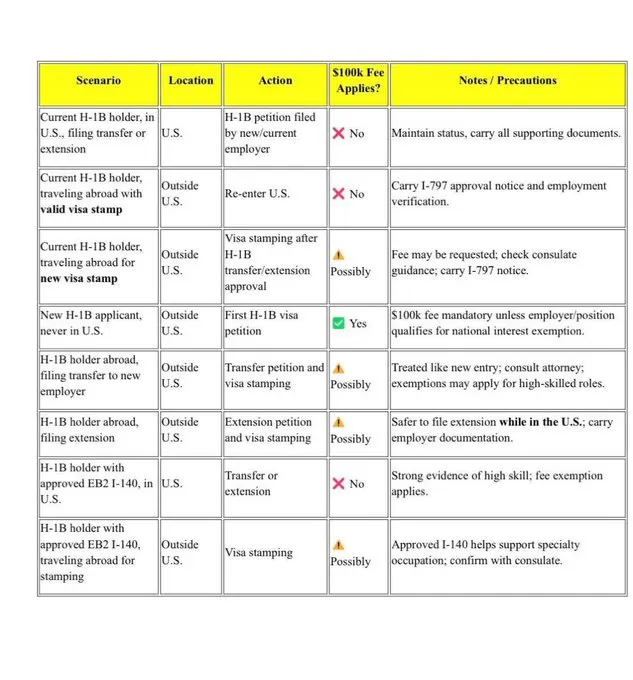
Current H1B holders need to understand how the policies affect renewals and extensions. Those currently abroad have been advised to return before September 21 to avoid immediate complications. Transfer applications between employers will also be subject to the new fee structure.
H1B dependent companies and their spouses face particular uncertainty, as the policies could affect family immigration options and long-term settlement plans in the United States.
Alternative Immigration Options and Strategies
Given the new H1B restrictions, exploring alternative pathways for skilled foreign workers has become increasingly important.
O-1 visas for individuals with extraordinary ability offer an alternative for highly skilled workers, bypassing the H1B lottery system and providing a direct path to permanent residency consideration. EB-1A petitions for outstanding researchers and professionals have seen increased interest as companies seek alternatives to the restricted H1B program.
L-1 visas for intracompany transfers remain available for multinational companies, though they require existing overseas operations. Other options include E-2 investor visas for entrepreneurs and various temporary worker categories depending on specific circumstances.
Preparing for the New H1B Landscape
Employers and foreign workers must adapt their strategies to navigate the dramatically changed H1B environment effectively.
Companies should conduct cost-benefit analyses for each potential H1B sponsorship, considering the $100,000 annual fee alongside higher wage requirements and compliance costs. Strategic workforce planning becomes crucial to identify positions that truly justify the investment.
Foreign workers should explore alternative immigration pathways, consider developing extraordinary ability qualifications for O-1 visas, and maintain flexible career planning given the uncertain H1B environment. Building strong documentation of achievements and specialized skills becomes more important than ever.
FAQs
What is the new H1B visa fee and when does it take effect?
President Trump imposed a $100,000 annual fee for H1B visa applications, effective September 21, 2025. This applies to both new applications and renewals, representing a massive increase from current fees of under $1,000.
Is H1B visa stamping still available within the USA?
No, the domestic H1B visa stamping pilot program ended in April 2024. H1B holders must now travel abroad to U.S. embassies or consulates for visa stamping.

Do I need an H1B visa lawyer for the new requirements?
Given the complex new fee structure, higher wage requirements, and potential legal challenges, consulting an H1B visa attorney is strongly recommended. Legal guidance can help navigate compliance requirements and maximize approval chances.
How does Trump’s H1B visa policy affect current visa holders?
Current H1B holders abroad should return before September 21, 2025. Renewals and transfers will be subject to the new $100,000 fee. The policy primarily affects new entries rather than existing status holders.
What are the alternatives to H1B visas given the new restrictions?
Alternative options include O-1 visas for extraordinary ability, EB-1A permanent residency petitions, L-1 intracompany transfer visas, and E-2 investor visas. Each has specific requirements and may be more suitable than H1B under current conditions.
Can companies get exemptions from the $100,000 H1B fee?
The Secretary of Homeland Security can grant waivers if employing H1B workers serves national interest and doesn’t threaten security or welfare. However, specific criteria for these exemptions haven’t been detailed yet.
What should I do if I’m planning H1B visa stamping abroad?
Traditional stamping processes continue at U.S. embassies and consulates worldwide. Allow extra time for processing, prepare comprehensive documentation, and consider consulting an immigration attorney given the changing policy environment.
The landscape for H1B visa stamping in USA and the broader H1B program has fundamentally changed in 2025. While challenges are significant, understanding these changes and working with qualified legal counsel can help navigate this complex new environment successfully.