
The ongoing federal government shutdown has led the Federal Aviation Administration (FAA) to announce a significant reduction in flights to maintain safety amid staffing shortages. Starting Friday, flight operations will be cut by 10 percent at 40 major U.S. airports, predominantly those with the highest traffic volumes.
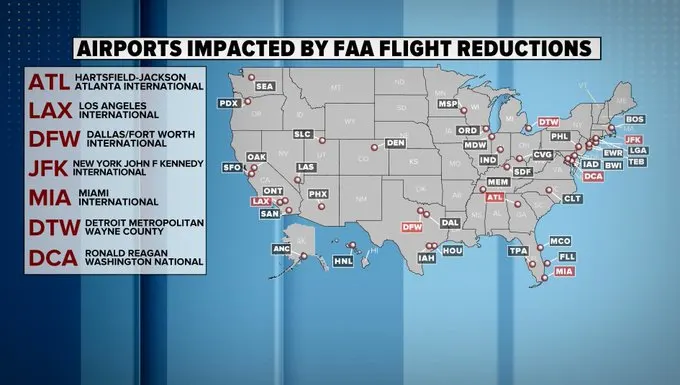
This decision, brought forward by FAA Administrator Bryan Bedford and Transportation Secretary Sean Duffy, aims to prevent safety issues before they arise due to the fatigue and reduced capacity of air traffic controllers working without pay for over a month.
Airports are experiencing major delays as the FAA continues urging Congress to end the government shutdown. NewsNation's @VenturaReport says spikes in absences as paychecks are delayed for thousands of air traffic controllers.
MORE: https://t.co/BUupLnPtxW pic.twitter.com/G1d41huSYD— NewsNation (@NewsNation) November 3, 2025
The Federal Aviation Administration (FAA) is expected to publish a list on Thursday detailing the airports impacted by the anticipated decrease in flight operations, as the government shutdown extends into an unprecedented 37 days. The reductions are scheduled to commence on Friday and are intended to ensure safety in the skies, given the staffing shortages worsened by the current funding lapse.
Air traffic controllers have been working mandatory overtime six days a week, leading to increased absences and significant travel disruptions nationwide. Estimates suggest that as many as 1,800 flights and 268,000 seats could be impacted, causing potential delays and cancellations at major hubs like Chicago O’Hare, New York City airports, Los Angeles, Dallas, and Atlanta.

Airlines such as United and Southwest have committed to minimizing consumer disruption by adjusting schedules and offering refunds or rescheduling options for affected travelersAir traffic controllers have been working without pay since the start of the shutdown. Absences among controllers have increased leading to travel disruptions nationwide.

The Associated Press reported…that as many as 1,800 flights and 268,000 seats could be affected. United Airlines CEO Scott Kirby said the airline shares the FAA’s goal of air safety and will continue working with the agency, which has directed every airline to reduce their schedules during the government shutdown.
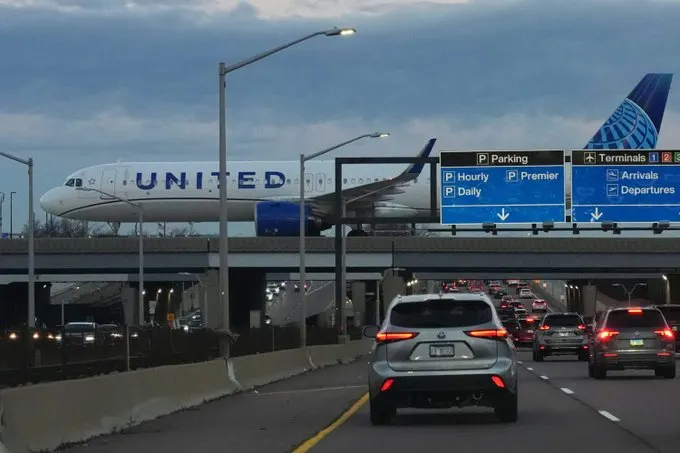
FAA officials emphasized that the measures are precautionary and aimed at maintaining an “extremely safe” airspace environment despite the shutdown’s unprecedented length and pressure on staff. Should staffing levels deteriorate further, the FAA is prepared to implement additional restrictions or more severe measures.
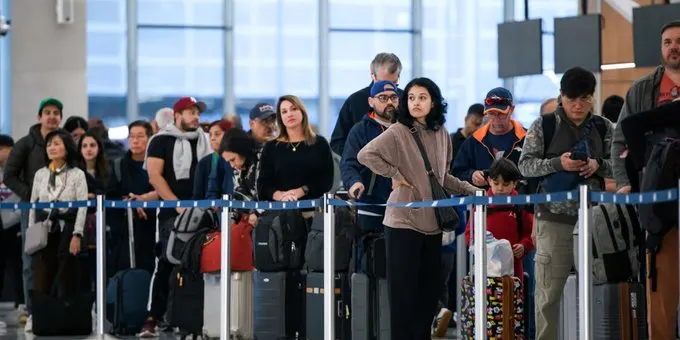
This ongoing situation has underscored the crucial role of federal employees in aviation safety and highlighted the operational challenges that arise during extended federal shutdowns. We’re not going to wait for a safety problem to truly manifest itself when the early indicators are telling us we can take action today to prevent things from deteriorating,” Bedford said. “The system is extremely safe today and will be extremely safe tomorrow. If the pressures continue to build even after we take these measures, we’ll come back and take additional measures.”